
Call us now :07315122648
 Send Inquiry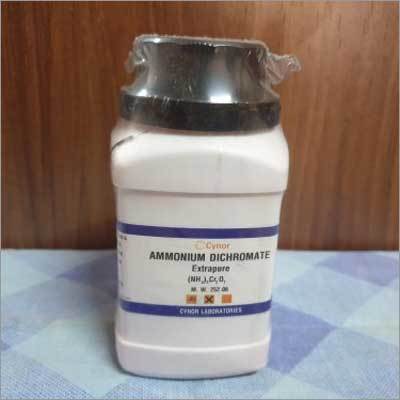
Ammonium Dichromate
381 INR/Piece
Product Details:
- Purity 99% (EXTRA PURE)
- Packaging Type Plastic bottle / HDPE jar
- Size Typically available in 500g, 1kg, 5kg packs
- Density 2.15 Gram per cubic centimeter(g/cm3)
- Usage Suitable for analytical and research laboratory use
- Boiling point Not applicable (decomposes)
- Storage Instructions Store in tightly closed containers, in a cool, dry place away from incompatible materials
- Click to View more
X
Ammonium Dichromate Price And Quantity
- 1 Kilograms
- 381 INR/Piece
Ammonium Dichromate Product Specifications
- 99% (EXTRA PURE)
- 252.06 g/mol
- Non-flammable
- Typically available in 500g, 1kg, 5kg packs
- 170°C (decomposes)
- Orange-red crystalline powder
- Laboratory reagent, pyrotechnics, catalyst, photography
- 7789-09-5
- Plastic bottle / HDPE jar
- University Lab Chemicals
- (NH4)2Cr2O7
- Acidic
- EXTRA PURE
- 2.15 Gram per cubic centimeter(g/cm3)
- Not applicable (decomposes)
- Suitable for analytical and research laboratory use
- 99%
- Solid
- Store in tightly closed containers, in a cool, dry place away from incompatible materials
- 36 months from manufacturing date
- Transport according to local, national and international regulations
- 1439
- Soluble in water, insoluble in alcohol
- 6.1 Toxic Substance
- Strong oxidizer, reacts violently with organic material
- Chromium oxides, Nitrogen oxides, Water Vapor
- Odorless
- 28415090
Ammonium Dichromate Trade Information
- Cash Advance (CA)
- 1000 Kilograms Per Day
- 15 Days
- Yes
- Sample costs shipping and taxes has to be paid by the buyer
- Australia, South America, Western Europe, Middle East, Africa, Central America, Asia, Eastern Europe, North America
- Dadra and Nagar Haveli, Chandigarh, Himachal Pradesh, Manipur, Nagaland, Uttarakhand, Daman and Diu, Lakshadweep, South India, North India, East India, West India, Andaman and Nicobar Islands, Andhra Pradesh, Assam, Arunachal Pradesh, Chhattisgarh, Delhi, Gujarat, Goa, Haryana, Jammu and Kashmir, Jharkhand, Karnataka, Madhya Pradesh, Maharashtra, Mizoram, Meghalaya, Punjab, Pondicherry, Rajasthan, Sikkim, Tamil Nadu, Telangana, Tripura, West Bengal, Bihar, Kerala, Central India, Odisha, Uttar Pradesh, All India
Product Description
Product details
|
CAS Number |
7789-09-5 |
|
Form |
Power |
|
Brand |
Cynor |
|
Purity |
99 % |
|
Packaging Size |
100 gm |
|
Usage/Application |
Laboratory use |
|
Packaging Type |
Bottle |
Packaging available like 100 gm, 500 gm , 5 Kg etc.
Physical Properties and Safety
Ammonium Dichromate presents as a vivid orange-red crystalline solid, designed specifically for precision laboratory analysis and research. As a powerful oxidizer and classified under Hazard Class 6.1, it should be handled with strict safety precautions. Storage in tightly closed containers, in cool, dry environments away from incompatible substances such as organic material, is crucial to preventing hazardous reactions. The product is odorless, non-flammable, and has a shelf life of up to 36 months.
Applications in Laboratories and Industry
This compound serves as a versatile analytical reagent in university labs and research facilities. Common applications include acting as a catalyst, initiating reactions in pyrotechnics, and contributing to photographic processes. Its consistently high purity (99%) ensures reliable results in sensitive experiments. Ammonium Dichromate's reactivity and decomposition products make it indispensable in controlled laboratory settings where expertise and suitable safety measures are assured.
FAQ's of Ammonium Dichromate:
Q: How should Ammonium Dichromate be safely stored and handled in a laboratory setting?
A: Store Ammonium Dichromate in tightly sealed containers made of plastic or HDPE, placed in a cool, dry location away from incompatible materials, especially organic substances. Always use proper protective equipment and work in well-ventilated areas due to its toxicity and strong oxidizing properties.Q: What are the main uses of Ammonium Dichromate in research and industry?
A: Ammonium Dichromate is widely utilized as a laboratory reagent in analytical procedures, as a catalyst in chemical reactions, in pyrotechnics for triggering ignition, and in photographic processes due to its reliable oxidizing capability and high purity.Q: When does Ammonium Dichromate decompose, and what products are formed?
A: Ammonium Dichromate decomposes at 170C, producing chromium oxides, nitrogen oxides, and water vapor as decomposition products. It does not have a traditional boiling point, as it breaks down before boiling.Q: Where can Ammonium Dichromate be transported, and what are key transport considerations?
A: Transportation of Ammonium Dichromate must comply with local, national, and international regulations, including its classification as a toxic substance (UN number 1439). Appropriate packaging and documentation are required to ensure safe transit and legal compliance.Q: What is the process for using Ammonium Dichromate as an analytical reagent?
A: To use Ammonium Dichromate in analysis, dissolve it in water (as it is water-soluble), and incorporate it into chemical assays as specified for your application. Ensure strict adherence to safety protocols due to its toxic nature and strong reactivity.Q: What are the benefits of using Ammonium Dichromate with 99% Extra Pure grade?
A: Utilizing Ammonium Dichromate with 99% purity ensures high reliability and accuracy in laboratory reactions, minimizing risks of impurities affecting experimental outcomes in research and industrial processes.Tell us about your requirement

Price:
Quantity
Select Unit
- 50
- 100
- 200
- 250
- 500
- 1000+
Additional detail
Mobile number
Email

Other Products in 'Laboratory Chemicals' category

 Send Inquiry
Our Products
- Laboratory Chemicals
- Metal Powder
- Industrial Chemicals
- Pharmaceutical Chemicals
- Industrial Acid
- Calcium Carbonate
- Ph Indicator Paper
- Isopropyl Alcohol
- Ph Testing Paper
- Fertilizers
- Chemical Test Kits
- Insecticides
- Starch Powder
- Laboratory Reagents
- Chemical Dyes
- Chemical Liquid
- Acetic Acid
- Reactive Dyes
- Speciality Chemicals
- Chemical Compound
- Indicators
- Fine Chemicals
- LIQUID LAB CHEM
- Chemical Powder
- Api Intermediate
- Potassium Salts
- Intermediates
- Specialty Chemical
- Sodium Salts
- Silver Salts
- Pharmaceutical Intermediates
- Water Treatment Chemicals
- Pharma Intermediates
- Cosmetic Chemicals
- Pyridine Derivatives
- Active Pharmaceutical Ingredients
- Laboratory Equipment
- Chemical
- CALCIUM SALTS
- Acids
- Liquid Chemical
- Dyes Intermediates
- Laboratory Glassware
- SPE CHEMICAL
- Organic Chemicals
- Benzene
- Chemical Solvent
- Acetophenone


Plot No. 1411, Shop No. S-17, Second Floor, Global Trade Centre, Mega Chowkdi,Ankleshwar - 393002, Gujarat, India

Mr Uttambhai Vaghasiya
(Partner)
Mobile :07315122648
 Send Inquiry
 Send SMS
 Call Me Free
Developed and Managed by Infocom Network Private Limited.
 English
 Spanish
 French
 German
 Italian
 Chinese (Simplified)
 Japanese
 Korean
 Arabic
 Portuguese