
Call us now :07315122648
 Send Inquiry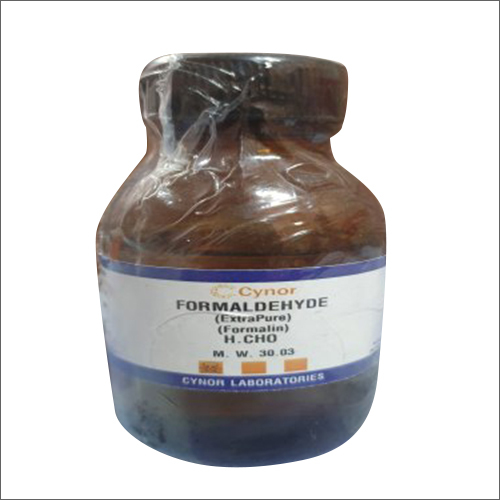
Formaldehyde H CHO
211 INR/Piece
Product Details:
- Boiling point -19 0b0C (for gas), 96 0b0C (Formalin solution)
- Shelf Life 24 Months
- Storage Instructions Store in a cool, well-ventilated place, keep container tightly closed
- Molecular Formula CH2O
- Size 500 ml, 1 L, 2.5 L packaging available
- Purity 98%
- Physical State Liquid
- Click to View more
X
Formaldehyde H CHO Price And Quantity
- 1 Bottle
- 211 INR/Piece
Formaldehyde H CHO Product Specifications
- 98%
- 30.03 g/mol
- 2.8 - 4.0 (Formalin Solution)
- Clear colourless liquid with pungent odour
- -19 0b0C (for gas), 96 0b0C (Formalin solution)
- EXTRA PURE
- University Lab Chemicals
- Liquid
- 98%
- 50 °C (Formalin solution)
- -92 b0C
- 1.08 Gram per cubic centimeter(g/cm3)
- Laboratory, Industrial, Disinfectant, Preservative, Chemical Synthesis
- Used for preservation of biological specimens, manufacture of resins, laboratory reagent
- 50-00-0
- 24 Months
- Store in a cool, well-ventilated place, keep container tightly closed
- Bottle, Drum
- 500 ml, 1 L, 2.5 L packaging available
- CH2O
- Liquid/Formalin aqueous solution
- 1198
- UN 1198, Class 3 (Flammable Liquid), Class 8 (Corrosive)
- Contains traces of methanol as stabilizer
- 1.377
- Miscible with water, ethanol and ether
- Stable under recommended storage conditions
- Pungent, irritating odour
- 37-40% (as Formalin Solution)
- 200-001-8
Formaldehyde H CHO Trade Information
- Cash Advance (CA)
- 1000 Bottle Per Day
- 15 Days
- Yes
- Sample costs shipping and taxes has to be paid by the buyer
- 100ml
- Australia, South America, Western Europe, Middle East, Africa, Central America, Asia, Eastern Europe, North America
- Lakshadweep, Himachal Pradesh, Andaman and Nicobar Islands, Uttarakhand, Daman and Diu, Dadra and Nagar Haveli, South India, East India, Andhra Pradesh, Assam, Arunachal Pradesh, Bihar, Chandigarh, Delhi, Gujarat, Goa, Haryana, Jammu and Kashmir, Jharkhand, Kerala, Madhya Pradesh, Maharashtra, Mizoram, Meghalaya, Manipur, Punjab, Pondicherry, Sikkim, Tamil Nadu, Telangana, Tripura, West Bengal, Nagaland, Odisha, Rajasthan, Karnataka, North India, Central India, West India, Chhattisgarh, Uttar Pradesh, All India
Product Description
We are a noteworthy manufacturer of Formaldehyde H CHO in the market. It is a strong-smelling, colorless gas used in making building materials and many household products. This Formaldehyde H CHO is used in pressed-wood products, such as particleboard, plywood, and fiberboard; glues and adhesives; permanent-press fabrics; paper product coatings; and certain insulation materials.
Versatile Applications in Science and Industry
Formaldehyde is widely utilized for the preservation of biological specimens, production of resins, and as a key laboratory reagent. Its reliability and purity make it suitable for chemical synthesis and as a disinfectant in industrial contexts. The liquid form ensures precise dosing and consistent results across varied scientific and manufacturing tasks.
Safety and Storage Recommendations
Due to its classification as both a flammable (Class 3) and corrosive (Class 8) liquid (UN 1198), Formaldehyde should be stored in a cool, well-ventilated area. Keep containers tightly sealed to maintain stability and ensure safe usage. Proper handling and adherence to recommended storage instructions guarantee a shelf life of up to 24 months.
FAQ's of Formaldehyde H CHO:
Q: How should Formaldehyde (Formalin solution) be stored for optimal stability?
A: Formaldehyde should be stored in a cool, well-ventilated place, with the container tightly closed. This ensures its stability and preserves its shelf life, which is up to 24 months under recommended conditions.Q: What are the main laboratory and industrial uses of Formaldehyde?
A: Formaldehyde is commonly deployed as a preservative for biological specimens, a disinfectant, a laboratory reagent, and a precursor in chemical synthesis for resin manufacturing. Its versatility makes it valuable across scientific and industrial applications.Q: When should additional precautions be taken handling Formaldehyde?
A: Extra precautions are necessary when handling Formaldehyde due to its flammability and corrosive nature. Use appropriate protective equipment and work in well-ventilated areas to minimize exposure to its pungent, irritating odour and vapours.Q: Where can Formaldehyde be applied in a laboratory setting?
A: Formaldehyde is used in laboratory environments for specimen preservation, disinfection procedures, and as a reagent in chemical experiments. Its miscibility with water, ethanol, and ether enhances its usefulness in diverse laboratory processes.Q: What is the benefit of using extra pure grade Formaldehyde?
A: Extra pure grade formaldehyde offers a high level of purity (98%), which reduces the risk of contamination in sensitive laboratory, research, or industrial processes, enabling more consistent and reliable results.Q: How is Formaldehyde delivered and what sizes are available?
A: Formaldehyde is supplied in liquid form (Formalin solution) and packed in bottles or drums. Packaging options include 500 ml, 1 L, and 2.5 L sizes to accommodate different usage requirements.Q: What does the presence of methanol as a stabilizer imply for users?
A: Methanol is added as a stabilizer in Formalin solutions to prevent polymerization of Formaldehyde. Users should be aware of its presence, follow safety guidelines, and consider methanol in risk assessments during handling or experimentation.Tell us about your requirement

Price:
Quantity
Select Unit
- 50
- 100
- 200
- 250
- 500
- 1000+
Additional detail
Mobile number
Email

Other Products in 'Laboratory Chemicals' category

 Send Inquiry
Our Products
- Laboratory Chemicals
- Metal Powder
- Industrial Chemicals
- Pharmaceutical Chemicals
- Industrial Acid
- Calcium Carbonate
- Ph Indicator Paper
- Isopropyl Alcohol
- Ph Testing Paper
- Fertilizers
- Chemical Test Kits
- Insecticides
- Starch Powder
- Laboratory Reagents
- Chemical Dyes
- Chemical Liquid
- Acetic Acid
- Reactive Dyes
- Speciality Chemicals
- Chemical Compound
- Indicators
- Fine Chemicals
- LIQUID LAB CHEM
- Chemical Powder
- Api Intermediate
- Potassium Salts
- Intermediates
- Specialty Chemical
- Sodium Salts
- Silver Salts
- Pharmaceutical Intermediates
- Water Treatment Chemicals
- Pharma Intermediates
- Cosmetic Chemicals
- Pyridine Derivatives
- Active Pharmaceutical Ingredients
- Laboratory Equipment
- Chemical
- CALCIUM SALTS
- Acids
- Liquid Chemical
- Dyes Intermediates
- Laboratory Glassware
- SPE CHEMICAL
- Organic Chemicals
- Benzene
- Chemical Solvent
- Acetophenone


Plot No. 1411, Shop No. S-17, Second Floor, Global Trade Centre, Mega Chowkdi,Ankleshwar - 393002, Gujarat, India

Mr Uttambhai Vaghasiya
(Partner)
Mobile :07315122648
 Send Inquiry
 Send SMS
Developed and Managed by Infocom Network Private Limited.
 English
 Spanish
 French
 German
 Italian
 Chinese (Simplified)
 Japanese
 Korean
 Arabic
 Portuguese