
Call us now :07315122648
 Send Inquiry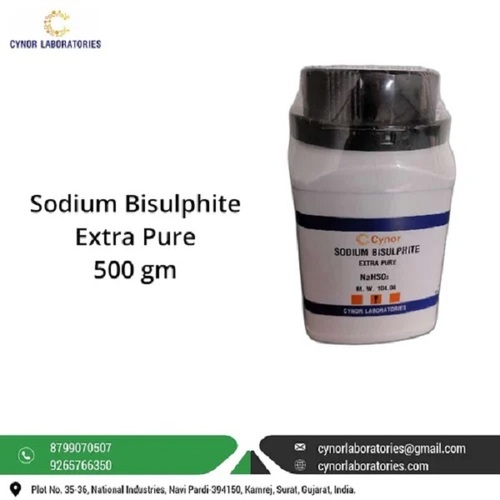
sodium bisulphite
330.00 INR/Bottle
Product Details:
- Packaging Type HDPE Bags, Drums
- Flash Point Non-flammable
- Storage Instructions Store in a tightly closed container, in a cool and dry place
- Molecular Weight 104.06 g/mol
- Melting Point 150°C (decomposes)
- Ph Level 4.0 - 5.0 (5% solution)
- Physical State Solid
- Click to View more
X
sodium bisulphite Price And Quantity
- 330.00 INR/Bottle
- 1 Bottle
sodium bisulphite Product Specifications
- HDPE Bags, Drums
- Store in a tightly closed container, in a cool and dry place
- Scientific Lab Chemicals
- Non-flammable
- Laboratory
- 24 months
- White to yellowish crystalline powder
- NaHSO3
- 7631-90-5
- 104.06 g/mol
- 99
- 4.0 - 5.0 (5% solution)
- 150°C (decomposes)
- 1.48 Gram per cubic centimeter(g/cm3)
- Chemical Synthesis, Water Treatment, Textile, Pulp & Paper, Food Preservative
- NA (decomposes before boiling)
- Solid
- 99%
- Custom packaging available
- Preservative, Antioxidant, Laboratory Use
- Soluble in water
- Non-hazardous for transport
- Strong acids, oxidizing agents
- Not applicable (solid)
- 231-548-0
- <0.001%
- Sulfur dioxide gas
- Slight sulfur dioxide odor
- 28321090
sodium bisulphite Trade Information
- Cash Advance (CA), Cash in Advance (CID)
- 100 Bottle Per Day
- 10 Days
- Sample costs shipping and taxes has to be paid by the buyer
- Australia, Central America, North America, South America, Eastern Europe, Western Europe, Middle East, Africa, Asia
- Chandigarh, Himachal Pradesh, Manipur, Uttarakhand, Dadra and Nagar Haveli, South India, North India, East India, West India, Andaman and Nicobar Islands, Assam, Arunachal Pradesh, Bihar, Delhi, Daman and Diu, Gujarat, Goa, Haryana, Jammu and Kashmir, Jharkhand, Karnataka, Kerala, Lakshadweep, Madhya Pradesh, Maharashtra, Mizoram, Meghalaya, Nagaland, Pondicherry, Rajasthan, Sikkim, Tamil Nadu, Telangana, Tripura, West Bengal, Uttar Pradesh, Punjab, Andhra Pradesh, Central India, Odisha, Chhattisgarh, All India
Product Description
Sodium bisulfite (or sodium bisulphite, sodium hydrogen sulfite) is a chemical mixture with the approximate chemical formula NaHSO3. Sodium bisulfite in fact is not a real compound,[2] but a mixture of salts that dissolve in water to give solutions composed of sodium and bisulfite ions. It appears in form of white or yellowish-white crystals with an odor of sulfur dioxide.Versatile Applications Across Industries
Sodium bisulphite's adaptability makes it valuable across a wide variety of sectors. It is used as a reducing agent in chemical synthesis, an antioxidant and preservative in the food industry, and helps in water purification processes by removing excess chlorine. Textile and pulp & paper industries also employ it for specific treatment steps that enhance product quality and stability.
Safe Storage and Handling Guidelines
For optimum stability, store sodium bisulphite in tightly sealed containers away from strong acids and oxidizers. Keep it in a cool, dry place to prevent decomposition and an unwanted release of sulfur dioxide gas. The substance is non-hazardous for transport, reducing related regulatory concerns during shipping and distribution.
Quality and Purity Assurance
Our sodium bisulphite boasts a minimum purity of 99% with heavy metal content below 0.001%, ensuring it meets rigorous laboratory-grade specifications. Each batch is available in customizable packaging, and the product's compliance with CAS No. 7631-90-5 and EC Number 231-548-0 makes it a reliable choice for researchers and industry professionals alike.
FAQ's of sodium bisulphite:
Q: How is sodium bisulphite typically used in water treatment and chemical processes?
A: Sodium bisulphite acts as a dechlorinating and reducing agent in water treatment plants, effectively removing excess chlorine. In chemical synthesis, it's used to reduce or react with certain compounds, making it indispensable in laboratory and industrial processes.Q: What precautions should be taken when storing and handling sodium bisulphite?
A: It should be stored in a tightly closed container within a cool, dry area, away from strong acids and oxidizing agents. This prevents premature decomposition and limits the release of sulfur dioxide gas, ensuring both safety and product longevity.Q: When does sodium bisulphite decompose, and what are the main decomposition products?
A: Sodium bisulphite decomposes at around 150C, releasing sulfur dioxide gas as the primary decomposition product. It does not have a boiling point since it breaks down before boiling.Q: Where can sodium bisulphite be applied besides the laboratory setting?
A: Beyond laboratories, sodium bisulphite is widely used in the textile and pulp & paper industries for processing and preservation. It also serves as a food preservative, antioxidant, and in water treatment facilities for chlorine removal.Q: What packaging and customization options are available for sodium bisulphite supply?
A: Sodium bisulphite is supplied in HDPE bags and drums, with custom packaging sizes available upon request. This ensures compatibility with specific industry needs and storage requirements.Q: What distinct benefits does laboratory-grade sodium bisulphite offer?
A: Laboratory-grade sodium bisulphite ensures high purity (99%) with minimal heavy metal contamination (<0.001%), providing reliable results in sensitive applications. Its stringent quality control makes it suitable for scientific, industrial, and food-grade uses alike.Tell us about your requirement

Price:
Quantity
Select Unit
- 50
- 100
- 200
- 250
- 500
- 1000+
Additional detail
Mobile number
Email

Other Products in 'Laboratory Chemicals' category

 Send Inquiry
Our Products
- Laboratory Chemicals
- Metal Powder
- Industrial Chemicals
- Pharmaceutical Chemicals
- Industrial Acid
- Calcium Carbonate
- Ph Indicator Paper
- Isopropyl Alcohol
- Ph Testing Paper
- Fertilizers
- Chemical Test Kits
- Insecticides
- Starch Powder
- Laboratory Reagents
- Chemical Dyes
- Chemical Liquid
- Acetic Acid
- Reactive Dyes
- Speciality Chemicals
- Chemical Compound
- Indicators
- Fine Chemicals
- LIQUID LAB CHEM
- Chemical Powder
- Api Intermediate
- Potassium Salts
- Intermediates
- Specialty Chemical
- Sodium Salts
- Silver Salts
- Pharmaceutical Intermediates
- Water Treatment Chemicals
- Pharma Intermediates
- Cosmetic Chemicals
- Pyridine Derivatives
- Active Pharmaceutical Ingredients
- Laboratory Equipment
- Chemical
- CALCIUM SALTS
- Acids
- Liquid Chemical
- Dyes Intermediates
- Laboratory Glassware
- SPE CHEMICAL
- Organic Chemicals
- Benzene
- Chemical Solvent
- Acetophenone


Plot No. 1411, Shop No. S-17, Second Floor, Global Trade Centre, Mega Chowkdi,Ankleshwar - 393002, Gujarat, India

Mr Uttambhai Vaghasiya
(Partner)
Mobile :07315122648
 Send Inquiry
 Send SMS
Developed and Managed by Infocom Network Private Limited.
 English
 Spanish
 French
 German
 Italian
 Chinese (Simplified)
 Japanese
 Korean
 Arabic
 Portuguese